
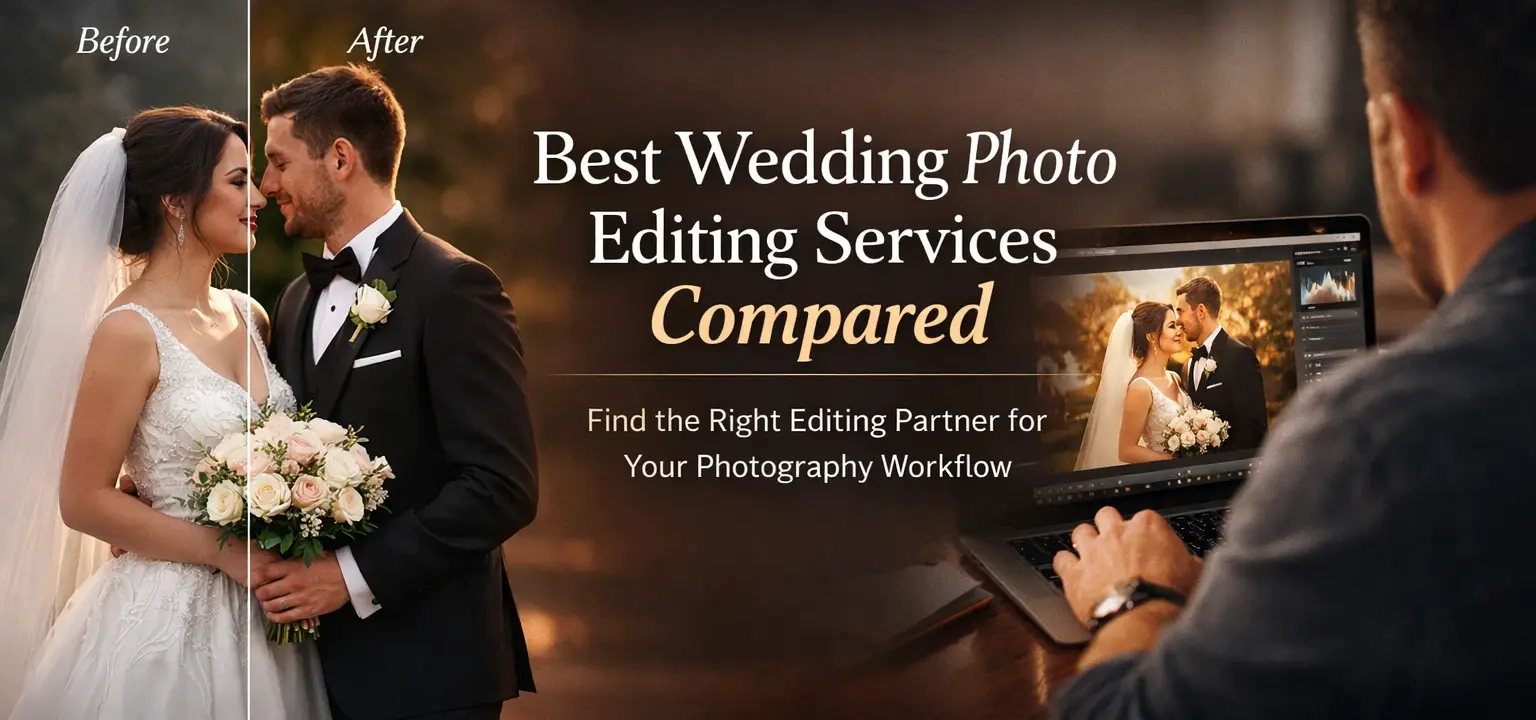
High-volume studio operators are no longer the only ones who choose to outsource wedding photo editing. In 2026, full-service studios, part-time photographers, and independent photographers all make this common business option. The math is straightforward: it takes 15 to 30 hours to edit a single wedding. When you multiply that over the course of an entire season, post-production takes up more of your working time than shooting.
As a result, the market for expert wedding photo editing services has expanded. These days, there are a plethora of possibilities, from professional post-production firms with wedding editing teams to individual freelancers on creative markets. Some provide a 24-hour turnaround time. Others can match styles deeply. Some provide monthly subscription rates based on volume, while others are paid per image. It’s not always easy to decide between them, and sending your raw files to an editor who can’t match your style or satisfy your turnaround requirements is an expensive error that negatively impacts your client relationships.
This article was created for wedding photographers who are actively exploring outsourcing options and would like an honest, methodical comparison of what to look for, what questions to ask, and how to assess services before committing. Understanding what that specialization actually means in practice is part of what this guide covers. Services like Photodotedit have built their entire model around the specific needs of wedding photographers, covering everything from bulk culling and color correction to advanced retouching and album design. Whether you are reviewing your current editing partner or outsourcing for the first time, the structure that follows will help you make a solid choice.
Why Photographers Outsource Wedding Editing in 2026
The discourse surrounding outsourcing has changed. Many photographers were reluctant to outsource editing five years ago since it seemed like an admission that they couldn’t manage their own workload. A more sophisticated grasp of what it truly takes to run a photographic business has largely replaced that stigma.
Time is the primary motivator. A photographer would spend 60 hours a month on post-production alone if they shot three weddings a month and spent 20 hours editing each one. There is hardly any space left over for marketing, customer service, developing relationships with vendors, ongoing education, or relaxation. When a photographer reaches this stage, it’s not because they enjoy shooting too much; rather, it’s because editing has taken up every minute that wasn’t already spent on a wedding day.
The rationale for skill specialization goes beyond time. Although they are related, shooting and editing are two distinct fields. Some photographers are proficient in Lightroom and outstanding behind the camera. Others are adept at both, but they just lack the time. Through outsourcing, photographers can collaborate with experts who edit effectively daily while focusing on their area of greatest skill and customer value: shooting.
A scaling argument is also present. You cannot increase your business by hiring a second shooter, accepting more dates, or branching out into destination weddings while editing every photo from every event. The operational capacity needed for expansion is created through outsourcing.
In 2026, the question of outsourcing will be “which service is right for my workflow and style?” rather than “should I?” due to the rapid advancement of AI-assisted editing tools and the growing specialization of professional editing services.
What to Look for in a Wedding Photo Editing Service
Not every editing service is built for wedding photography. Here are the criteria that matter most.
Wedding specialization: Wedding images involve mixed reception lighting, shifting outdoor light, group shots, detail shots, and the full emotional range of a 10-hour event. A service primarily editing real estate or product photos simply does not carry the experience to handle these consistently. Look for services whose portfolio is built around wedding work.
Style matching: Your editing style is your brand. Strong services learn your look — they do not impose their own. This requires a structured onboarding process: reference galleries, preset sharing, and a sample edit before your first full order.
Verifiable before-and-after work: Ask for real full-gallery examples, not just polished hero images. You want to see how a service handles skin tones, shadow detail, highlight recovery, and consistency across an entire event.
Clear communication: Editing is iterative. You need a responsive point of contact for feedback and questions — not just an automated inbox.
Data security: You are handing over someone else’s most personal images. How a service stores, handles, and protects those files is non-negotiable.
Turnaround Time: 24h vs 72h vs 1-Week Services
One of the most crucial practical considerations when selecting an editing partner is turnaround time, which differs greatly throughout the industry.
- The fastest tier, 24-hour turnaround services, is especially useful for photographers who are shooting back-to-back weekends without a buffer or who guarantee clients a sneak peek within 48 hours of the wedding. A firm promoting 24-hour delivery on 500 photographs should be able to show that their quality holds at that pace, not just their speed. This is the trade-off to watch out for.
- For the majority of working wedding photographers, a turnaround time of 48 to 72 hours is ideal. It keeps your delivery pipeline going without sacrificing quality for speed by allowing you to submit files early in the week and receive modified photographs back before the next weekend. For typical orders, the majority of expert, dedicated wedding editing services operate in this area.
- Freelance editors controlling their own schedules or services handling extremely high volume without proportionate team capability are typically the ones offering turnaround times of one week or more. A one-week editing turnaround is ideal for photographers whose contracts have four to six-week delivery periods. It puts undue pressure on photographers who promise quicker delivery.
What to ask: Are weekends included in the turnaround time quoted? If you provide 3,000 raw files instead of 1,500, what will happen to the timeline? What is the schedule for rush delivery, and is it possible for an extra cost? Make sure you understand these things before placing your first order, rather than in a hurry.
Style Matching: How Good Editors Replicate Your Lightroom Style
The aspect of the outsourcing process that photographers are most concerned about is style matching, which is also the area where the difference between mediocre and superior editing services is greatest.
It takes more than just using a preset to replicate a photographer’s editing approach. It necessitates an understanding of the style’s intent, such as why you lift shadows in outdoor portraits but hold them in moody indoor shots, why your skin tones run slightly warmer in summer weddings but cooler in autumn venues, and how much clarity and texture you prefer at various focal lengths and lighting conditions.
How strongly a service’s approach to style matches:
They begin with a methodical onboarding procedure. Three to five reference galleries, completely edited pieces that showcase your style in various lighting scenarios and wedding styles, are required of you. You share your LUT files or Lightroom presets. Your preferences for contrast, saturation, skin tone treatment, and how you manage particular situations like intense noon light or mixed tungsten and natural light may all be covered in a style quiz.
Before processing your entire order, the service creates a style-matched sample edit, which typically consists of five to ten photographs from your actual raw files. This sample provides you with a tangible point of evaluation. Before the entire order is processed, you give detailed comments and ask for corrections if the sample is incorrect. If it is close but not precise, you describe the difference in precise, useful terms.
Red flags in style matching:
Style matching is not taken seriously by an editing service that does not request reference galleries before starting work. A service that prioritizes speed above alignment returns a complete 500-image edit on the first order without a sample review phase. Furthermore, it is doubtful that a service will significantly improve over time if it responds to style input with general assurances rather than precise adjustments.
Before it becomes consistent, strong style matching usually requires two to three rounds of editing with a new service. Before making any judgments, assess a new editing partner across at least three complete wedding orders and factor that calibration period into your expectations.
Pricing Models: Per Image vs Per Hour vs Subscription
There are several pricing structures used by wedding photo editing services, and knowing the trade-offs between them can help you select the model that best suits your company.
Per-image pricing: The most popular and open price approach is per-image pricing. For every image you edit, you pay a set fee that increases in direct proportion to your volume. In 2026, culling will typically cost between $0.03 and $0.06 per image, color correction will cost about $0.10 per image, and professional retouching will cost between $1.50 and $6.00 per image, depending on complexity. Per-image pricing maintains costs precisely proportionate to income and is simple to anticipate and incorporate into your own pricing structure.
Per-hour pricing: Compared to dedicated services, individual freelance editors are more likely to charge by the hour. The problem with hourly pricing is that it’s hard to predict how long a certain gallery will actually take. Per-image pricing is typically more predictable unless you have a well-established relationship with an hourly editor and a clear notion of their pace and quality.
Subscription or monthly package pricing: For photographers with steady, high volume, a subscription or monthly package price is the most economical option. In comparison to regular per-picture pricing, a subscription plan usually covers a set number of photographs per month at a bundled rate that is less expensive per image. When compared to ordering the same service separately, a package that covers up to 2,100 photos for color correction, culling, and straightening at a set monthly charge gives significant savings per image. You are paying for capacity you are not utilizing if you have a slow month and submit far fewer photographs than your plan covers. This is a trade-off because subscription value is dependent on continuous volume.
The right model for you: Your shooting volume and consistency will determine which model is best for you. Per-image pricing frequently works better for photographers who shoot one or two weddings a month with fluctuating volume. Subscription options are typically more cost-effective for photographers who regularly photograph four or more weddings each month.
How Many Revisions Should You Expect?
The honest answer: unlimited, until the edit matches your agreed-upon style standard.
This does not mean unlimited requests for entirely different looks. It means that if a service delivers work that does not match your reference galleries and written style brief, they fix it at no additional charge. That is the appropriate level of accountability for style-matched work, and it is the standard Photodotedit holds itself to.
Avoid any service that charges per revision round after the first delivery. That structure creates an incentive to get it wrong.
Before committing to any service, confirm: Are revisions free? Is there a cap on rounds? How quickly are revisions turned around? Is your feedback handled by the same editor or a general queue?
Security and NDA: Protecting Your Clients’ Photos
When you outsource editing, you are sending unprocessed files that include photos of actual individuals on one of their most private days. Because your clients did not permit a third party to handle their photos, there is an ethical and legal component that photographers sometimes overlook.
What responsible editing services provide:
A Non-Disclosure Agreement that expressly forbids the editing team from utilizing, disseminating, publishing, or keeping customer photos after they have been edited. Instead of being something you have to ask for, this ought to be a basic component of the service agreement.
Using secure file transfer protocols, you can send altered photographs back and receive your raw data. Reputable providers don’t keep your files on unprotected or publicly accessible servers and instead employ encrypted transfer mechanisms.
a precise data retention strategy that guarantees files are erased or destroyed after delivery and details how long they are retained. This shields your clients from having their photos stored in a third-party system indefinitely.
On your end, think about including a provision regarding the usage of professional editing aid in your own client contracts. This is becoming more and more prevalent in the industry and puts you in a transparent position without raising any red flags. Most clients are at ease knowing that their photographer collaborates with a skilled post-production team, just as they are aware that a restaurant has a kitchen staff rather than a single cook.
Communication: Email-Only vs Dedicated Account Manager
Every time something needs to be discussed, fixed, or escalated—which frequently occurs in an active editing relationship—the editing service’s communication approach has an impact on your experience.
Email-only services: All correspondence is handled by email-only services via a single inbox. Using the same channel, you place your order, get automated status updates, and provide feedback. When everything goes according to plan, this model performs satisfactorily. The absence of a direct human contact point rapidly becomes annoying, whether there is a style issue, an urgent turnaround request, or a question regarding a particular image.
Dedicated account manager models: With dedicated account manager models, you are paired with a specific contact who is familiar with your account, style preferences, shooting schedule, and service history. Feedback is sent to someone already familiar with your situation. You don’t always have to start over with a new support agent when you have a query regarding a rush order.
The dedicated account manager strategy is significantly superior for photographers who often outsource in large quantities. Instead of being a transactional file exchange, the relationship develops into a true professional partnership.
Photodotedit keeps communication straightforward and human. You can reach the team via email at [email protected] or [email protected], call directly at +91-8130136092, or jump on WhatsApp for instant answers on pricing, order status, style questions, or anything else that comes up. For photographers who want quick, direct responses rather than ticket queues and automated replies, WhatsApp access in particular makes a practical difference during the busy season.
Before committing to any service, ask: Who is my point of contact? How fast do they respond? Is there a direct channel beyond email? Test it before you sign on — send a pre-sales question and note both the response time and whether the answer is genuinely useful.
What Photodotedit Offers vs General Alternatives
The market for wedding photo editing encompasses everything from independent contractors on broad creative platforms to specialized post-production services designed with professional photographers in mind. It is easier to understand the practical differences when you know where Photodotedit stands in that environment.
General creative platform freelancers:
General creative platform freelancers offer variable pricing and inconsistent quality. Style matching is informal, revision policies vary by individual, and formal NDAs are rare. If your editor becomes unavailable, your workflow is immediately disrupted.
Large-volume editing services:
Throughput is more important to large-volume editing services than subtlety. Although they can swiftly process large amounts of images, style matching is sometimes restricted to preset applications rather than true stylistic comprehension. Automated and impersonal communication is common. For photographers with straightforward, high-volume demands and little style intricacy, these services are sufficient.
Photodotedit is designed with wedding photographers and photographic studios in mind. RAW conversion, culling, color correction, detail editing, skin retouching, background replacement, artistic editing, and digital album creation are all included in the service. Standard orders have a 24-hour turnaround time; bigger volumes or more complicated editing requirements require longer turnaround times.
With monthly subscription packages that offer significant savings for photographers with regular monthly volume, the pricing structure ranges from $0.03 to $0.06 per image for culling and roughly $0.10 per image for color correction. The standard plan covers up to 2,100 images, while the pro plan covers up to 3,500 images. For an extra fee per image, advanced retouching services, including skin smoothing, hair repair, dodge and burn, sky replacement, and object removal, are offered.
The service’s mix of wedding-specific experience, style-matching process, transparent pricing, and the range of services offered within a single continuous partnership sets it apart from more generic competitors. Photographers collaborate with a single partner throughout the whole post-production process rather than overseeing many suppliers for culling, color correction, and retouching.
Request a Free Style-Matched Sample Edit from Photodotedit
The most direct way to evaluate any editing service is not to read about it — it is to see what they do with your actual files.
Photodotedit offers a free trial edit for new clients. Send five images from a recent wedding — a mix of ceremony, portraits, and reception shots that reflect your typical lighting and style range — and receive them back edited to your specifications. No commitment, no generic samples.
If it matches your vision, you have found a post-production partner that returns 15–20 hours per wedding back to you. If it does not, you have lost nothing but the time it took to send five photos.
Send your five trial images today and see what style-matched, professional wedding photo editing looks like for your work specifically.
Do you specialize in wedding photography, or do you edit across multiple genres?
Specialization is important. A staff that edits weddings on a daily basis gains stylistic fluency and pattern awareness that generalist editors just cannot match.
How do you approach style matching for a new client?
Reference galleries, preset sharing, a sample edit prior to the whole order, and a feedback loop should all be part of the solution. It is a symptom if the response is ambiguous.
Can I see before-and-after examples from real wedding projects?
Real full-gallery before-and-after pairs that show consistency throughout an event, not simply polished star photos.
What is your standard turnaround time, and how does that scale with volume?
Find out the answer for a case when you submit a larger-than-usual batch, as well as your average order size.
What is your revision policy?
Verify whether revisions are included, how many rounds are typical, and how quickly revisions are delivered.
Do you sign an NDA, and what is your data security protocol?
This query should have an easy-to-understand, prompt response from a professional service.
Who will I be communicating with, and how quickly do they respond?
Before you commit, test this by sending a pre-sales query and noting the quality of the response as well as the response time.
Do you offer a free trial edit?
Before you place a paid order, any reliable, high-quality editing service should be prepared to show you their work on your real files. It is noteworthy if a service refuses to provide any kind of trial.